TECHNICAL NOTE – MAGNETI MARELLI HARLEY-DAVIDSON INJECTION SYSTEMS (1995-2001)
Understanding how the Magneti Marelli system works and installing LE POTATO 2.0®
Harley-Davidson introduced its first electronic fuel injection system ("EFI" for Electronic Fuel Injection) from 1994/1995.
This first generation of injection was developed in collaboration with Magneti Marelli, a division of the Italian equipment manufacturer Weber, world-renowned for its carburetors.
The Magneti Marelli system will primarily equip Harley-Davidson motorcycles with 1340 Evolution until 1999, then the first Twin Cam 1450cc motorcycles until the end of 2001.
A little-known characteristic
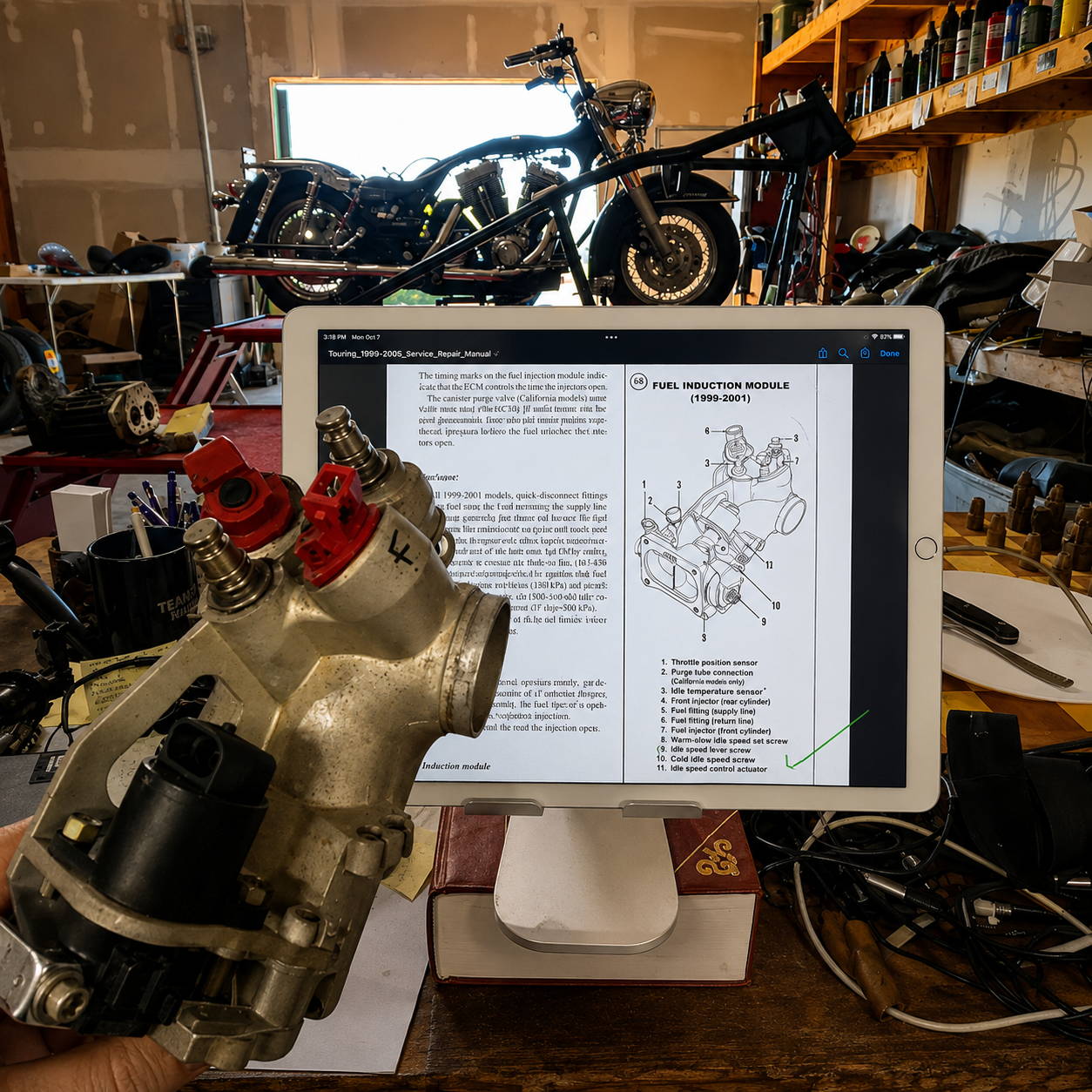
Harley-Davidson engineers in Milwaukee had planned on these systems a small mechanical adjustment screw called in the original documentation “Cold Idle Speed Screw” .
This screw indirectly affects the guard of the regulating mechanism arm and therefore the minimum opening of the throttle bodies.
Over time, this screw has become particularly difficult to identify:
- Its location is not easily accessible.
- It is often hidden behind the control mechanism.
- After more than 25 years of service, it is frequently oxidized or seized up.
- It is regularly confused with the original calibration screws of the throttle body.
A common confusion
Many owners mistakenly believe that the adjustment screws visible on the throttle body need to be changed to adjust the idle speed.
That's a mistake.
The synchronization and calibration screws of the injection body, especially those sealed at the factory by a protective varnish, must never be modified.
These settings are made at the factory by Harley-Davidson and modifying them can result in:
- engine malfunction;
- a desynchronization of the butterflies;
- an unstable idle;
- difficulties in development.
Why remove the original screw?
Originally, the Magneti Marelli system used this cold idle screw to act on the position of the regulating mechanism.
However, unlike the LE POTATO 2.0®, its operation was impractical:
- By tightening the screw, the idle speed increased;
- By loosening the screw, the idle speed decreased.
After several decades of use, this screw is often blocked by oxidation and no longer allows for precise or comfortable adjustment.
When installing the LE POTATO 2.0®, it is usually necessary to locate and then remove this original screw in order to free up the entire adjustment range of the system.
THE POTATO 2.0®: a modern and accessible solution
The POTATO 2.0® was designed to replace this original adjustment function with a system:
- entirely mechanical;
- easily accessible;
- precise and progressive;
- Adjustable at any time without complex disassembly.
It allows the driver to manually adjust the idle speed according to their preferences while maintaining the integrity of the injection body and without interfering with the factory settings of the Magneti Marelli system.
Important recommendation
Before any intervention on a Magneti Marelli system:
✅ Locate and identify the original cold idle speed screw.
✅ It is essential to retain the factory settings of the throttle body.
❌ Never modify the synchronizing screws or screws sealed with a protective varnish.
In the vast majority of cases encountered over the past ten years, adjustment difficulties simply stem from the original screw becoming difficult to locate or blocked by oxidation, and not from a defect in the LE POTATO 2.0® or from poor calibration of the injection body.